
Resident doctors in England have accepted the Government’s latest offer on pay and jobs.
This was not a landslide. According to the BMA, 52.9% voted yes, 47.1% voted no, and turnout was 57%. In other words, the deal passed, but almost half of those who voted rejected it. That matters, because a narrow acceptance is not the same as a profession feeling settled.
The Government will see the deal as the end of a long-running dispute. The BMA describes it as progress, but not full pay restoration. Doctors will look at it more practically.
Does this make staying in the UK feel worthwhile?
Does it fix the training bottleneck?
Does it make the UK competitive with Australia, Canada, Ireland or Germany?
And when you include the NHS Pension Scheme, is the UK package actually better than many doctors think?
The answer is this:
The deal improves the UK position, but it does not solve the retention problem. The pay rise helps. The training-place commitment is more important. The NHS pension is a genuine long-term advantage. But for many resident doctors, the UK still lags on immediate pay, career certainty and perceived quality of life.
What has actually been accepted?
The accepted offer includes an average 6.6% pay uplift, fully delivered by April 2027. All doctors receive the 3.5% DDRB uplift backdated to April 2026, with an additional average 3.1% delivered through nodal point reform over the following 10 months. The Government has also said the 2027 DDRB recommendation will be implemented in addition.
For the newest doctors, the Government says Foundation Year 1 basic full-time pay rises from £38,831 to £41,226. Foundation Year 2 pay rises from £44,439 to £47,610. The most experienced full-time resident doctors move from £73,992 to £77,348 before additional earnings.
It is a real improvement to pay, but the pay is not the most interesting part of the deal.
The more important part is the jobs package.
The offer includes up to 4,500 additional specialty training posts over three years, with 1,000 posts expected over the next year and 250 starting in February 2027. It also includes reimbursement of mandatory Royal College exam fees, portfolio fees from April 2027, Royal College membership fees from April 2027, reforms for locally employed doctors, and changes designed to make less-than-full-time progression fairer.
For resident doctors, especially those trying to move into competitive specialties such as surgery, anaesthetics, radiology or emergency medicine, this matters.
A pay rise helps this year, a training number gives you a career.
The biggest positive is not pay. It is progression.
The UK has not just had a pay problem, it has had a big career bottleneck problem.
For 2026, NHS England estimated around 40,000 individual applicants made roughly 74,000 CT1/ST1 applications for around 10,000 training posts. That creates a competition ratio of 3.8 applicants per post by individual applicants, or 7.4 applications per post when measured by total applications.
In 2025, Core Surgical Training had 5,399 applications for 630 posts, a competition ratio of 8.57.
For a future trauma and orthopaedic surgeon, that is the reality.
You can work hard, build your portfolio, pass exams, move hospitals, take on extra projects, and still find the door into training extremely narrow. That is demoralising. It also changes behaviour. Doctors who cannot see a route through the UK system start looking elsewhere.
That is why the 4,000 to 4,500 training places are the most meaningful part of the deal.
It is not just about earning more money this month. It is about whether the NHS can offer a credible career path to the doctors it has already trained.
The limitation is also clear. The BMA says none of the 4,500 posts will be in general practice. The posts will not eliminate competition in surgical and hospital specialties. They are also spread over three years. This is helpful, but it is not a full reset.
The deal improves the UK package, but it is not full pay restoration
The BMA has been clear that the deal is a step towards pay restoration, not the end of the campaign. It has said resident doctor pay still lags by nearly a fifth compared with 2008 levels.
That is why the narrow vote matters.
Doctors were not choosing between a perfect deal and no deal. They were choosing between accepting progress now, or continuing industrial action in pursuit of something closer to full restoration.
The deal gives resident doctors more money, better progression in the pay structure, some reimbursement of professional costs, better treatment for locally employed doctors, and additional training posts.
Those are real positives.
But the deal does not make the UK internationally competitive on immediate pay.
How does the UK now compare internationally?
International comparisons are never perfect. Tax, housing costs, training structures, overtime, immigration rules, indemnity, family life and pension systems all matter.
But doctors do not make career decisions in a spreadsheet. They make them by asking a simpler question:
“Where will I be better off, better supported, and more likely to progress?”
On that basis, the UK is still vulnerable.
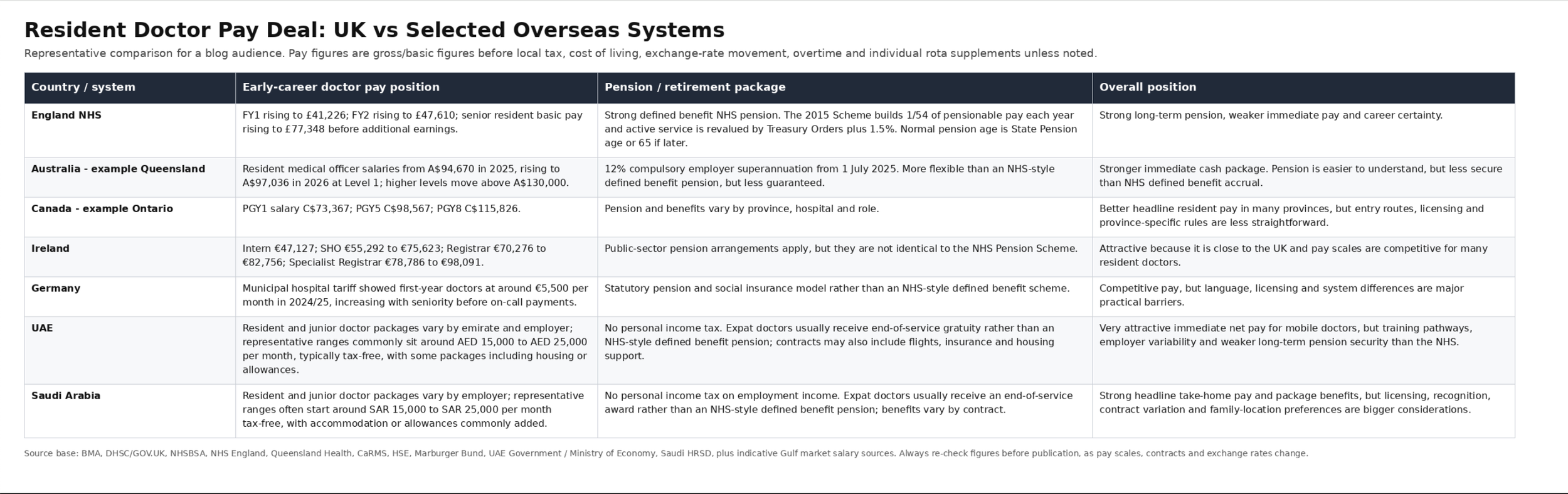
The UK does not come out as badly as some headline comparisons and commentators would suggest once the NHS pension is included.
But for a resident doctor in their late 20s or 30s, pension value is deferred. Rent, childcare, exam fees, relocation costs and the training bottleneck are immediate.
That is the problem.
The NHS pension is extremely valuable over a full career. It is also poorly understood, often underappreciated, and not designed to make a tired doctor feel better about this month’s payslip.
The NHS pension is the UK’s hidden advantage
As someone who works with doctors on NHS pensions, I think this part is often missed.
The NHS Pension Scheme is a major part of total reward.
The 2015 Scheme is a career average defined benefit pension. Each year, a member builds pension based on 1/54 of pensionable pay. For active members, the pension earned is revalued each year by Treasury Orders plus 1.5%. The employer contribution rate is 23.7% of pensionable pay.
That is a significant benefit.
A doctor comparing a UK salary with an overseas salary should not ignore it. A defined benefit, inflation-linked pension payable for life is difficult and expensive to replicate privately. For doctors who remain in the NHS through training and into consultancy, the pension can become one of the most valuable assets they ever build.
But there are two reasons it does not solve the retention problem.
First, it is deferred.
A resident doctor deciding whether to move to Australia is not just comparing retirement income at 68. They are comparing rent, workload, morale, training access, exam costs and whether they feel valued now.
Second, the 2015 Scheme’s normal pension age is linked to State Pension age, or 65 if later. For younger doctors, that usually means a normal pension age of 67 or 68. That is a long way off for someone at ST3, ST5 or CT1.
The NHS pension helps the UK total package. It does not make the UK cash package competitive with Australia.
Will this deal stop doctors and surgeons leaving for Australia and Canada?
No.
It will stop some doctors leaving. It will make some doctors pause. It will make the UK feel more credible for those who were mainly worried about training bottlenecks, exam costs, LED insecurity or LTFT progression.
But it will not stop the exodus.
Australia remains especially attractive to UK-trained doctors after Foundation training. The GMC’s workforce analysis showed Australia was the main intended destination among doctors leaving the UK workforce who named a country in 2023. Of British nationals intending to move to Australia, 64% had completed F2 within the previous three years.
That tells you something important.
Many doctors are not leaving after a long consultant career. They are leaving early, at the point when they are most mobile, most frustrated by bottlenecks, and least emotionally attached to the NHS pension.
The Government has improved pay and jobs. It has not fixed workload, rota pressure, housing costs, childcare cliffs, training competition, morale, or the feeling among many doctors that the NHS asks too much and returns too little.
Canada is different. It is attractive, but entry is more complex. Training, licensing and province-specific rules make it less straightforward than the common “just move to Canada” narrative suggests. Australia remains the easier emotional comparator for many UK doctors: better weather, higher immediate pay, familiar clinical standards, and a clearer sense that work-life balance can improve.
The UK deal narrows the gap.
It does not close it.
Is the UK favourable overall?
The honest answer is: it depends what the doctor values, but the UK still lags where resident doctors feel the pressure most.
The UK is favourable for doctors who value a long-term NHS career, a defined benefit pension, structured training, consultant status, and the option to build private practice later.
The UK lags for doctors who prioritise immediate pay, predictable progression, quality of life, control over location, and the ability to save meaningfully in their 20s and 30s.
That is the central tension.
From a financial planning perspective, the NHS package is better than many doctors think.
From a resident doctor’s lived experience, the NHS package often feels worse than the Government thinks.
Both can be true.
What should resident doctors take from this?
The accepted deal is progress.
The pay rise is real.
The exam and portfolio fee changes are sensible.
The LED reforms are important.
The LTFT changes are overdue.
The training-place commitment is the biggest win.
But this is not full pay restoration, and it does not suddenly make the UK the most attractive place in the world for a highly trained doctor to build a life and career.
For doctors making decisions now, the right question is not simply:
“Should I stay or go?”
It is:
“What does each route give me in pay, progression, pension, family life and control?”
A doctor staying in the NHS should understand the value of their pension, their likely retirement age, their annual allowance position, and what they need outside the NHS pension if they want flexibility before 67 or 68.
A doctor moving overseas should understand what they are giving up as well as what they are gaining. Higher pay is attractive, but pension structure, licensing, career progression, tax, relocation costs and the ability to return to UK training all matter.
The UK has improved the offer.
But if policymakers think this deal alone will stop doctors leaving, they have misunderstood the problem.
Doctors are not leaving only because of pay.
They are leaving because the overall bargain feels broken.
This deal repairs part of it.
It does not rebuild the whole thing.
